
There’s a saying used by Special Ops forces – slow is smooth, smooth is fast.
Many people (maybe even most people) try to do things as fast as they can.
But to truly tap into your super powers, you have to train only as fast as you can do it perfectly. And that means starting out slow.
Super slow.
You only increase the speed as you get to the level where you are making no mistakes. Then you try it a little bit faster and work towards flawless.
This teaches your brain to do things the right way. When you go faster before you’re ready, you’re reinforcing mistakes.
When you can do things right, with no mistakes, you become fast. You flow and parts of a whole blend together.
This is where things start to slow down.
You actually get faster because
- you have fewer decisions
- variances and corrections are limited
- more mental bandwidth is available
- less energy is wasted on inefficiency
- elimination of pauses or transitions between actions
By getting rid of so many of the things that make us slower, we become faster.
In baseball, the batter has to use flow as he looks at each pitch that’s presented to him. The amount of time he has to react to the pitch is not enough for him to look at the individual steps of hitting.
He does not and can not wait for the pitch, decide where it’s going to come across the plate, approximate it’s speed, determine the movement of the ball up down or sideways, and assess whether or not it will be called a strike or a ball before he decides to swing or not.
He literally has to start swinging as if he knows the answer to all those questions and either swing or abort as he finds out each answer in milliseconds of that one act of swinging.
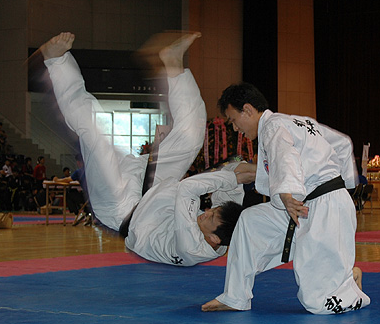
So when we practice martial arts, we should be practicing and perfecting each piece of what we do as a part of a whole.
When we put it together, we need it to flow like it’s one thought, one action, one move.
Another way to think about developing flow is to eliminate all pauses, resets, inefficiencies, etc.
When you are sparring, for example, don’t throw one kick or punch and then go back to a fighting stance. When you’re bringing your strike back, you should be delivering your next one right after. They should pass each other and your body should go from one side to the other, conserving and multiplying the energy, not bringing it to a stop only to start over from zero.
For example: if you throw a right punch, your hips turn to the left and allow your body to help send mass and momentum with the fist. As you draw your right hand back, and your hips turn to the right, bring your left fist up to deliver a punch or parry with the energy your body is already building in that direction. No pause, no reset, no inefficiency. Continuous energy. Flow.
The goal as we learn things is to take each part of the whole and perfect it. Then we put it all together and perfect the whole. Lastly, we make it seamless so that it truly becomes one thing and not a series of things.
Efficient. Effective.
This is flow.
