
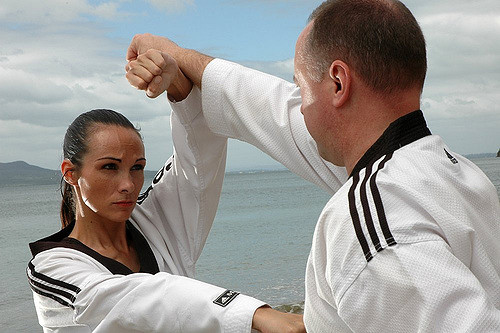
Although Tae Kwon Do is not considered one of our 5 core arts, there are things to be learned from most other arts, including this one.
Tae Kwon Do: The Art of Kicking, Spirit, and Precision
Tae Kwon Do is an art that focuses on kicks and strikes and strives for precision in their movements. It is a hard art and therefore more of a linear art and is very direct in it’s strikes, blocks, and attacks. One of the things you can find in a Tae Kwon Do class that demonstrates their power is board breaking.
Another thing that Tae Kwon Do is known for is their forms. Forms are a great way to practice certain movements over and over to learn to be more precise and automatic with a group of techniques.
Tae Kwon Do is one of the world’s most widely practiced martial arts, known for its spectacular kicks, dynamic movement, and emphasis on personal discipline. Originating in Korea, Tae Kwon Do blends centuries-old combative traditions with a modern philosophy of self-improvement, making it a powerful art for practitioners of all ages.
A Brief History
Although its roots stretch deep into Korean martial culture, Tae Kwon Do as we know it today began to take shape in the mid-20th century. After World War II, Korean martial artists unified various native and imported fighting systems into a standardized art. In 1955, the name Tae Kwon Do was officially adopted—roughly meaning “the way of the foot and fist.”
From there, Tae Kwon Do grew rapidly. Two major branches emerged:
• ITF (International Taekwon-Do Federation): Known for its emphasis on patterns (tuls), linear power, and traditional techniques.
• WT (World Taekwondo): Known for its Olympic sport format, fluid movement, and fast, high kicks.
Despite stylistic differences, both branches share the same core identity: a kicking-focused martial art built around discipline, respect, and self-mastery.
The Philosophy Behind the Art
At its heart, Tae Kwon Do is more than striking techniques—it is a path toward character development. The philosophy is often summarized through the Tenets of Tae Kwon Do, which include:
• Courtesy
• Integrity
• Perseverance
• Self-control
• Indomitable spirit
Students are encouraged to embody these qualities both inside and outside the dojang. The training aims to strengthen the body, sharpen the mind, and cultivate a spirit that does not give up in the face of challenge.
Signature Techniques and Training
Tae Kwon Do is famous for its dynamic kicking arsenal. Practitioners learn:
• Roundhouse kicks with speed and snap
• Side kicks that develop power and structure
• Spinning and jumping kicks that showcase athleticism
• Axe and hook kicks used to break an opponent’s balance
While kicks dominate, Tae Kwon Do also incorporates:
• Hand strikes and blocks
• Stances that train stability
• Patterns (forms) that build precision
• Sparring that develops timing and adaptability
The emphasis on flexibility, agility, and explosive movement makes Tae Kwon Do both visually impressive and physically demanding.
Self-Defense Applications
Although often associated with sport, Tae Kwon Do retains practical self-defense principles. Practitioners learn to:
• Generate power through proper hip rotation and body alignment
• Use fast, long-range kicks to keep attackers at a distance
• Apply blocks, strikes, and basic grappling concepts as needed
• Develop awareness, confidence, and strategic movement
The combination of physical techniques and mental conditioning helps students respond more effectively under pressure.
Benefits of Training
Tae Kwon Do offers benefits that extend far beyond combat skill:
• Improved strength, speed, and flexibility
• Better balance and coordination
• Stress relief and mental focus
• Goal-setting through belt progression
• A sense of community and mutual respect
Whether a student’s goal is fitness, confidence, competition, or personal growth, Tae Kwon Do provides a structured and rewarding path.
Conclusion
Tae Kwon Do remains one of the most influential martial arts in the world because it harmonizes tradition and modern training, physical dynamism and moral discipline. It teaches practitioners how to kick with power, move with precision, and face challenges with an indomitable spirit.
For anyone seeking a martial art that strengthens both body and character, Tae Kwon Do offers a lifelong journey of improvement and self-discovery.
For those who want to practice patterns and work on making some things automatic, here are the eight poomse forms of Tae Kwon Do.
Form 1
Form 2
Form 3
Form 4
Form 5
Form 6
Form 7
Form 8
